
Start with the work you want to win.
A landscaping company looking for recurring maintenance has a different growth question from one pursuing outdoor living projects. Both may appear in similar searches, but they need different service explanations, qualification questions and follow-up.
Before changing a profile or writing a page, we identify your preferred work, practical service radius, crew capacity and the questions a suitable customer asks. That gives each improvement a business purpose. More inquiries are not automatically better if they come from the wrong territory or ask for work you do not provide.
For businesses serving Lancaster County from a Berks base, clear service-area information helps customers recognize that you cover their location. ACS connects your actual territory with the services and projects you want to grow.
- Which jobs would you like more of?
- Which areas can you serve profitably and reliably?
- Who handles the first conversation, and what must they learn?
Record the starting point before changing it.
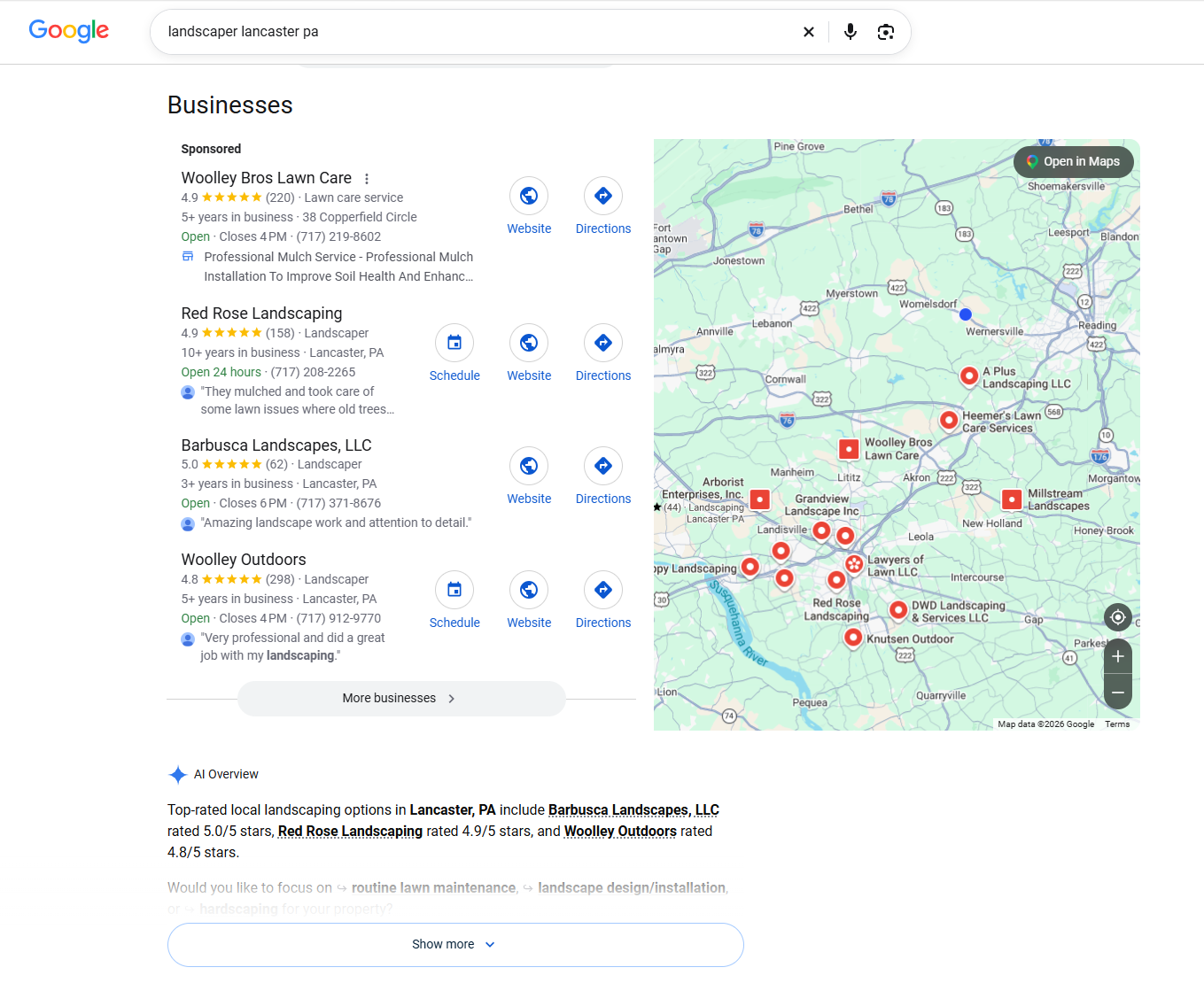
The first working step is to confirm website and Google Business Profile access. Then we choose the main service-and-location search to assess and establish a local ranking-grid baseline. A repeatable comparison records the query, date and geographic coverage rather than treating a single search from one location as the whole market.
I look at what strong competitors make clear: the services they lead with, the places they cover, their project evidence and the next step they offer. That gives us something concrete to compare with your current presence. We use the research to find gaps, not to copy another company or assume their results will be yours.
The website check compares public business information with the profile, reviews the title and main heading, inventories indexed content and checks structured data and the map connection. You receive a prioritized view of what needs attention, why it matters and the access needed to put the recommendations into practice.
- Confirm website and profile access.
- Choose the primary service-and-location query.
- Save a ranking-grid benchmark and competitor observations.
- Inventory website, profile and business-information gaps.
Make the profile accurate before making it busier.
Google Business Profile can help eligible businesses appear in local discovery. We begin with ownership, eligibility, the real-world business name, appropriate categories, phone, website, services and customer-facing hours. Access and owner approval are prerequisites for changes.
An address is not a ranking prop. If customers are not served at your address, the profile must follow the rules for your business type. A service-area business should not present an unstaffed location as a storefront. Adding cities to a service area does not guarantee visibility in them.
We review the primary category and necessary supporting categories, then complete the available profile fields using verified business facts. The service inventory starts with relevant research, removes duplicates and near-identical variants, and is checked with you before publication. Priority services receive concise descriptions within the platform’s character limits.
The business name stays consistent with the real-world name. Useful photos show real people and real work that you have permission to publish. Review requests invite genuine feedback. The owner confirms which services are actually offered and which images can be used before profile updates are made.
Give important services their own useful explanation.
A service page should help a customer decide whether to contact you. That means describing the work, who it suits, what happens during an estimate, the information you need and the limits of the service. A short list of keywords does not do that job.
We connect service pages with appropriate industry and regional context. A roofing page might distinguish a repair conversation from a replacement project. A remodeling page might explain project types and planning expectations. The detail comes from the business, not a generic paragraph with a different city name.
Technical foundations matter too: clear headings, descriptive titles, usable internal links, mobile readability and crawl access. Structured information must agree with visible facts. It is not a shortcut around weak content or a promise of special search placement.
- Explain the service and who it is for.
- Answer real pre-inquiry questions.
- Connect the page to a relevant next step.
- Use original, permission-cleared work where available.
Make the same business recognizable everywhere.
Outdated phone numbers, conflicting names and abandoned profiles create uncertainty. We compare the business name, publishable address information and phone across the website, profile and relevant listings. The basic citation review includes Bing, Apple Business Connect, Yelp, Foursquare and Data Axle where appropriate for the business and market.
The next pass researches directories appearing for the target searches and relevant sources used by competitors. We record existing listings, missing opportunities, correction needs and verification requirements. Together, we choose which corrections and listings are worth pursuing, with any account access and listing costs agreed before changes begin.
Useful local relevance comes from truthful service territory, relationships, approved project context and specific knowledge of how your business operates. A page for every nearby town is not a strategy if the pages say the same thing.
The scope may include a correction inventory and owner-approved updates. Access restrictions, verification requirements and third-party publishing decisions remain visible. We cannot promise that every platform will accept every change immediately.
Connect discovery to a conversation someone can act on.
Finding the business is only part of the journey. A visitor needs to understand whether their job fits, how to contact you and what will happen next. Phone links should work on mobile. Forms should ask for enough context without turning a first inquiry into an application.
The business also needs a clear owner for incoming inquiries. A form confirmation is not evidence that someone followed up, and a booked conversation is not a sold job. We keep those stages separate and connect this work to measurement and follow-up when that is the actual gap.
If the website cannot reliably receive an inquiry, adding more traffic can make the problem larger. We may recommend fixing the conversion path before expanding content or buying additional reach.
Keep the work moving after the first pass.
The workflow separates the basic foundations from advanced work. Benchmarking and profile completion come first, followed by on-page basics, service and area content, helpful internal links and citation work. Each stage needs a record of what changed and what still depends on access or business input.
An ongoing routine collects new, approved photos of the business and its work, requests genuine customer reviews and prepares useful profile updates. Weekly collection and review make these tasks easier to maintain. Real project photos and specific service updates give prospective customers a current view of your work.
Progress updates distinguish work completed from results observed. A later ranking review uses the original query and geographic coverage where possible, alongside inquiry evidence. The review informs the next cycle rather than turning every movement into a promise of revenue.
Know what is being changed, and why.
A scoped engagement can include a visible-presence review, profile correction plan, priority service content, internal-link improvements and an agreed measurement baseline. The exact deliverables depend on the site, access, market and business priorities.
You provide accurate business facts, access where needed, permission for photos and examples, and review of work descriptions. ACS organizes the findings, recommends priorities and implements the agreed changes. Paid work and responsibilities are agreed before implementation.
We review relevant visibility and inquiry evidence over time. Search results vary by location, device and query, so one screenshot is an observation, not a universal rank or proof of revenue. The useful question is whether the work is helping the right people find and understand your business.
A service is listed, but the next step is missing.
Illustrative scenario: an outdoor-services business lists hardscaping on its profile, but the website only describes general landscaping. A homeowner cannot tell what projects fit or what to send for an estimate.
- 1
Create a useful hardscaping page with project fit and estimate expectations.
- 2
Check the profile link, service information and actual territory.
- 3
Make the inquiry path usable and assign an owner for the response.
ACS applies this approach to your services, territory and goals, then recommends the work that deserves priority.
Choose the right starting point.
- Start here when
- Your profile, service content and local information do not tell a consistent story.
- Start somewhere else when
- People already find you, but cannot use the website or never receive a response. Fix that path first.
Before you decide.
Is local authority the same as Google Business Profile work?
The profile is one part. Local authority connects accurate identity, useful website content, real geography and a reliable inquiry path. A profile-only correction can still be a sensible smaller scope.
Can you guarantee a top Maps position?
No. Local results depend on multiple factors, including distance and competition. We can agree on the work and review evidence, not promise placement.
Do I need separate pages for every town?
No. Create a separate page only when it provides distinct, useful information. A truthful regional hub is better than a collection of near-duplicates.
Should I stop running Google Ads?
Not automatically. Paid search and organic discovery serve different purposes. The decision depends on demand, budget, response capacity and the quality of your current inquiry path.
What do I get from the free growth plan?
A review of visible opportunities and two or three recommended priorities, explained in a conversation with Alex. You leave with a clearer next step. Any paid implementation is scoped and priced separately.